 Download in PDF format | more articles..
One of a set of articles from Ionocom on electronic design topics.
Handling Substitutions in Bills of Materials
The transition of a bill-of-materials from the design phase of a project to the production phase can be complicated by the need to handle substitutions. A clear understanding of concepts helps to avoid problems.
Bill of Materials
The bill-of-materials (BOM) is a fundamental part of a drawing set defining an assembly to be manufactured. The BOM is an output of the design process, along with schematics, PCB artworks, assembly drawings, test specifications and so on.
The BOM specifies the parts to be used when manufacturing the assembly. Single-sourced parts are problematic because, without the leverage of competition, costs can be higher. They also expose a manufacturer to risk if the part is ever in short supply or discontinued.
For this reason BOMs must typically specify allowable substitutions. Two possible types of such substitutions are equivalent and alternate items.
Equivalent and Alternate Items
An equivalence is a relationship between two items that are identical in all aspects of form, fit and function. One item is completely interchangeable for the other in all situations.
An alternate is an item that, whilst not identical, may be substituted for another in a particular situation.
Examples
For example, M3x6 stainless steel machine screws meeting the DIN912 standard may all be considered equivalent. They are freely interchangeable on any assembly, irrespective of manufacturer, because they are essentially identical. This is an equivalence relationship, which you want to create once and never worry about again.
On the other hand, some substitutions are not universally allowable. On a particular printed circuit board a 25V-rated capacitor might be an allowable alternate for a 16V-rated part, provided other electrical details are similar. That same substitution might not be allowable on a different board, where the physically taller 25V part might not fit. And the parts are certainly not equivalent - using the 16V part on a design that specified the 25V part might be disastrous! This is an example of an alternate relationship, which must be created specifically for a particular situation.
Equivalents
Within a company, equivalence relationships exist independently of any particular bill-of-materials (BOM). If you call up one part on the BOM, all of the equivalent parts are automatically allowable substitutes. Typically you will create a "generic" part to use on BOMs, with all the real parts listed as equivalents. You create this equivalence relationship once, then call up the generic parts on as many BOMs as you like.
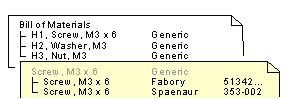
A procurement specification may be used to control which real parts are acceptable.
Alternates
Alternate relationships exist in specific situations, on a particular BOM.
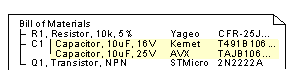
In the most pure approach alternate relationships apply to a particular line-item on a particular BOM. This can quickly get tedious if there are many instances of a part on a BOM and the same substitutions are allowable for all of them. A compromise approach is for alternate relationships to exist at the BOM level, not the line-item level. On a particular BOM one part may be defined as an allowable alternate for another, in all instances.
Use the Correct Relationship
It is important not to confuse the two type of relationships. Often we accidentally create equivalence relationships where we should create alternates. This can lead to problems later, when a new design unknowingly "inherits" the relationship.
Systemic Problem
One cause of problems is that many company's purchasing and manufacturing systems (ERP and MRP systems for larger enterprises) are very bad at handling either kind of relationship. They typically support the concept of a BOM calling up parts in terms of internal company part numbers. Each internal part number may have multiple vendors. An equivalence relationship can be created using this multiple-vendors feature. This is not ideal because it confuses the concepts of manufacturer and vendor, but it does at least work.
On the other hand, an alternate relationship is very difficult to create in these systems. If you try to create a special internal company part number for use on a particular BOM, then use the multiple-vendors feature to enter the allowable alternates, you will quickly run into problems. For example, the description field (there is only one) is a problem when the alternates may have different voltage ratings, sizes, or even values. In addition, your database quickly becomes cluttered with these special one-off parts. Furthermore, this creates a host of stock-keeping problems; your MRP system may tell you that you have no 10uF 16V capacitors in stock whereas you actually have plenty, in a bin labelled with a different one of these special one-off part numbers.
There are some good reasons for MRP systems' aversion to substitutions. Without them, product structures can be "exploded" and "flattened"; required parts quantities can be consolidated and compared with in-stock quantities; and purchasing lists for shortages prepared automatically. When allowable substitutes are introduced, decisions must be made as to which alternatives to choose. These decisions must often be manual.
Workaround
The simplest workaround is to keep all the substitution information on the paper BOM produced during design, and just enter lead parts into the purchasing and manufacturing systems. If a part ever becomes expensive or hard to source, the BOM can be consulted to find a substitute, and this can be entered to replace the lead part.
The best solution, if you can manage it, is to use a purchasing and manufacturing system which understands the concept of substitutions, and provides mechanisms that allow you to handle equivalent and alternate items.
Summary
The ability to specify allowable substitutions on a BOM is an essential requirement of the design process. There are two basic types of allowable substitution, represented by equivalent and alternate relationships.
Although the BOM that is the output of the design process may clearly express both types of relationship, there may be problems entering all the data into a company's purchasing and manufacturing systems.
Nevertheless, a clear understanding of the underlying concepts and the "ideal" implementation will allow you to keep a grip on the situation, even if your implementation has to be a compromise.
Ionocom's Strategy
As a contract design house, Ionocom often has to follow its client's style when creating bills-of-materials. However, we always follow the same underlying approach:
Internal part numbers are assigned one per unique part. An internal part number always relates to exactly one manufacturer and manufacturer's part number. If a second-source is identified for a part it always gets a new number, however identical it may appear.
Alternate relationships are created at the BOM level. A "lead" part is listed on the BOM, and an alternate relationship defines allowable substitutions. The relationship is good for the whole BOM. A BOM printout shows the lead parts, and a separate table shows the allowable substitutions.
Equivalence relationships are handled by creating "generic" parts and an associated procurement specification. Real parts meeting the specification are listed as allowable substitutions for the generic parts. The relationship is good everywhere, for all BOMs. The generic parts are called up on BOMs, and a BOM printout will then show the generic placeholders along with a separate table showing the allowable substitutions.
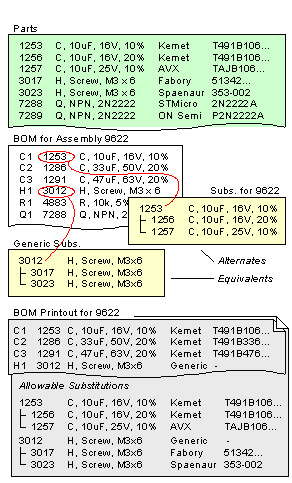
Ionocom uses an in-house database to manage parts and BOMs, and supplies its clients with "printouts" in the form of spreadsheets and PDF documents.
About the Author
Matthew Kendall is a principal of Ionocom Communications Inc., Vancouver, BC.
He has worked in electronic product design since 1987, first in Reading, England, and lately in Vancouver, BC, Canada.
He can be reached by email at matthew@ionocom.com.